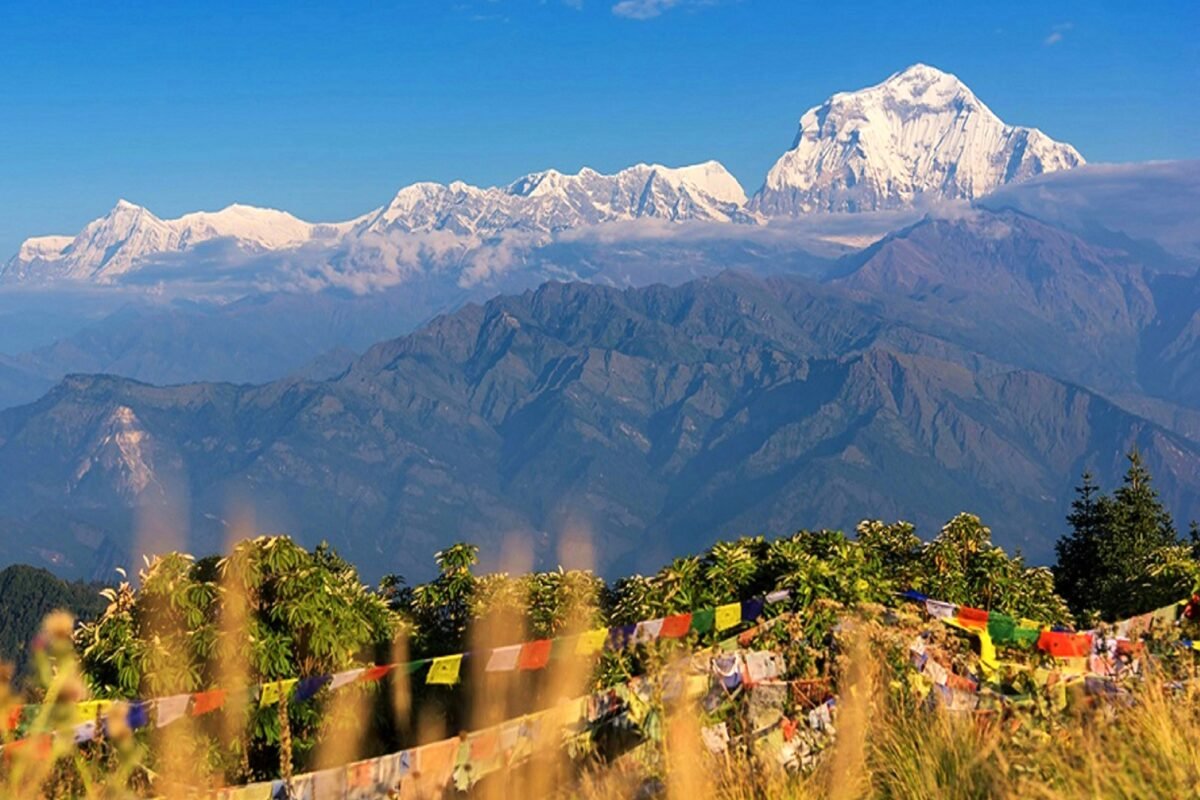
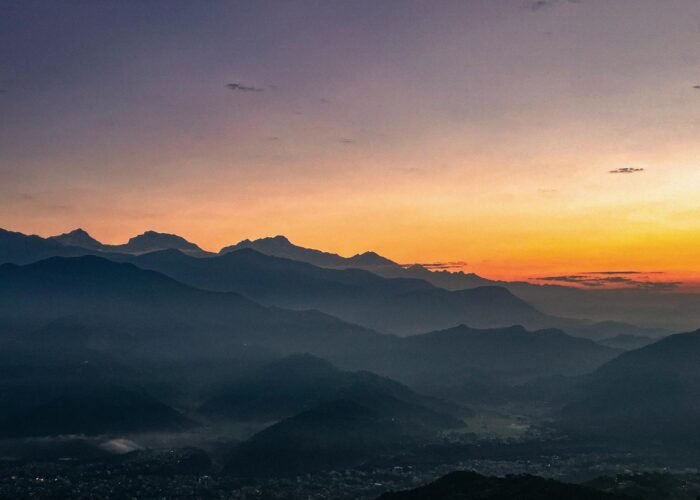
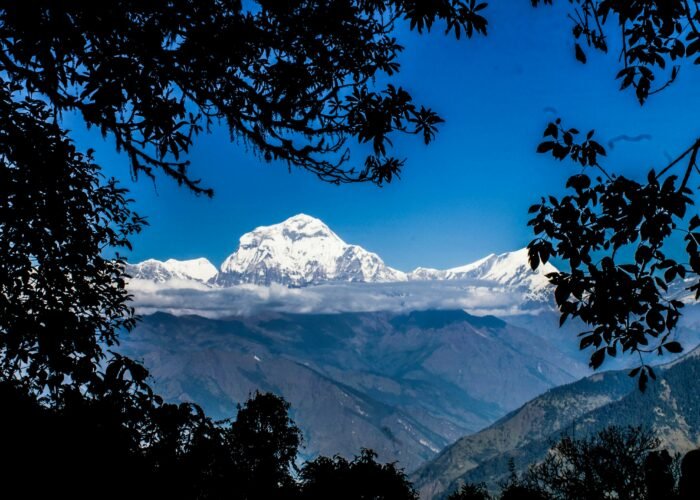
The Poon Hill sunrise is one of the most celebrated mountain viewpoints in Asia. Getting there is the Ghorepani Poon Hill Trek. Every year, thousands of trekkers from over sixty countries stand on a small hilltop in the Annapurna foothills at 3,210 metres and watch the sun rise over the highest mountains on earth.
The scene is always the same and always extraordinary, the sky turns from black to indigo to orange, and the peaks reveal themselves one by one from the darkness — Dhaulagiri (8,167m), Annapurna I (8,091m), Annapurna South (7,219m), Nilgiri (7,061m), and the sacred, perfectly proportioned Machapuchare (6,993m).
In 9 days from Kathmandu, the Poon Hill Trek delivers a complete Himalayan trekking experience — genuine high-altitude viewpoints, world-class rhododendron forest, traditional Gurung village culture, and the single most famous sunrise panorama in Nepal — without the altitude demands that characterise longer routes like Everest Base Camp or the Annapurna Circuit.
The maximum altitude of 3,210m keeps the risk of altitude sickness low. The daily walking time of 4–6 hours is manageable for reasonably fit adults without prior trekking experience. The teahouse infrastructure on this route is the best in Nepal.
This makes the Ghorepani Poon Hill Trek the ideal choice for first-time trekkers, families with older children, travellers with limited vacation time, and anyone who wants a genuine taste of Himalayan Nepal without committing to a 14–18 day high-altitude route.
This comprehensive guide covers the complete day-by-day itinerary, the Poon Hill sunrise experience in full detail, what to pack, when to go, permit requirements, costs, and why the rhododendron forest on this route is one of Nepal’s greatest natural spectacles.
The best short trek in Nepal. Nepal’s trekking routes range from two-day village walks to six-week Himalayan expeditions. The Poon Hill Trek sits in a sweet spot — long enough to feel like a genuine Himalayan adventure, short enough to fit into two weeks of vacation including flights. At 9 days door-to-door from Kathmandu, it is the most efficient way to experience the Nepal Himalaya.
The Poon Hill sunrise. Poon Hill’s sunrise panorama is justifiably one of the most famous mountain viewpoints on earth. No other easily accessible viewpoint in Nepal places so many significant peaks — Dhaulagiri, three Annapurna summits, Nilgiri, Hiunchuli, and Machapuchare — simultaneously within a single field of view at distances close enough to fill the horizon. On clear mornings in October and April, it is genuinely overwhelming.
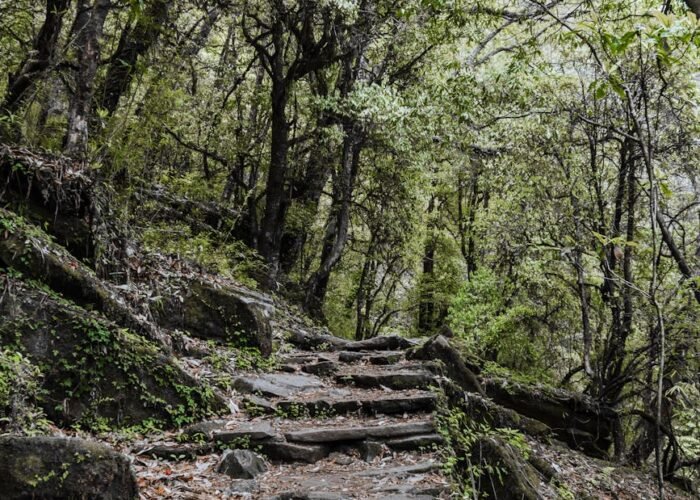
The world’s finest rhododendron forest. Nepal has 32 species of rhododendron, more than any country except China. The largest continuous rhododendron forest in the world covers the slopes between Tikhedhunga and Ghorepani, from 2,000m to 3,200m. From mid-March to late April, this forest blooms in progressive waves as temperature and altitude interact — the lower slopes first in early March, the upper forest still blooming in early May. Walking through it in full bloom is one of Nepal’s most extraordinary natural experiences.
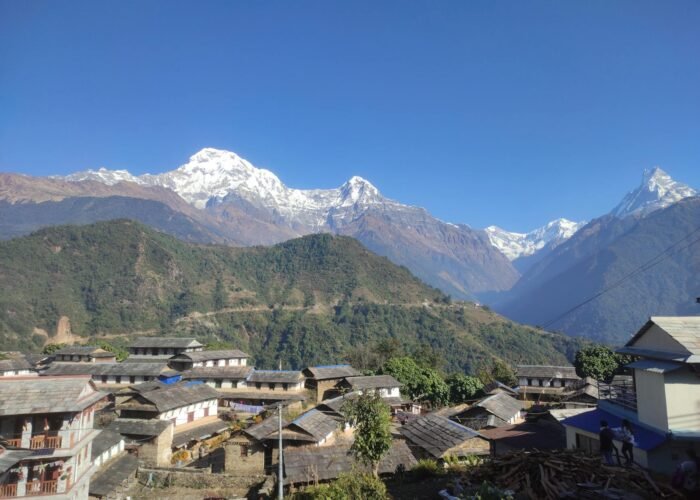
Gurung culture. The villages on the Poon Hill route — Ghandruk, Chhomrong, Tadapani, Ulleri — are predominantly Gurung. The Gurung people are one of Nepal’s most distinctive mountain cultures: historically renowned warriors (heavily represented in the Gurkha regiments of the British and Indian armies), known for their directness, hospitality, and the quality of their locally brewed raksi and chaang. The Gurung Museum in Ghandruk is one of the finest small museums in Nepal.
Accessible altitude. The maximum altitude of 3,210m (Poon Hill) is significantly lower than ABC (4,130m) or EBC (5,364m). At this elevation, the body adapts naturally without the specific acclimatisation protocols required at higher altitudes. Most healthy adults experience at most mild headaches or fatigue in the 2,800–3,200m range — manageable with hydration and rest.
Excellent infrastructure. The Poon Hill route has the most developed teahouse network in Nepal. Rooms are comfortable (twin share with simple furniture and blankets), hot showers are available at most stops (small charge per shower), the menus are extensive by trail standards (dal bhat, pasta, pizza, momos, pancakes, apple pie, fresh juice), and WiFi is available throughout.
The rhododendron forest between Tikhedhunga and Ghorepani is consistently described by botanists as the largest continuous rhododendron forest in the world. Understanding what makes it exceptional helps you appreciate what you’re walking through:
Species diversity: At least 12 species of rhododendron occur in this forest, each with a different altitude range and bloom period. Rhododendron arboreum (the tree rhododendron, Nepal’s national flower) dominates from 2,000–2,500m with deep crimson blooms. R. barbatum blooms at 2,500–3,000m in vivid red. Higher species — R. campanulatum (blue-violet) and R. lepidotum (pale yellow) — extend the bloom season into May.
Tree size: The rhododendrons here are not the low garden shrubs of Western countries. Many trees are 15–20 metres tall with trunks 40–70cm in diameter — genuinely arboreal in scale. The oldest trees are estimated at 150–200 years.
Bloom timing: The bloom moves up the altitude gradient over 6–8 weeks from late February to early May. Lower-altitude trees bloom first (late February to March), middle elevations peak in April, and the highest-altitude species bloom into early May. This means there is never a single “peak day” — the bloom is always happening somewhere on the trail from late February to early May.
Peak experience: Late March to mid-April gives the greatest coverage of simultaneous blooms across the widest altitude range. A trekker walking from Tikhedhunga to Ghorepani on April 5 in a good year will pass through continuous rhododendron bloom for essentially the entire day.
15+ years of Annapurna experience. We have guided trekkers on the Ghorepani Poon Hill route for over 15 years across every season. Our guides know every teahouse, every viewpoint, every shortcut, and exactly how to pace the Day 4 climb to ensure no one burns out before Ghorepani.
Government-licensed Sherpa guides. Every guide holds a Nepal government trekking guide licence and first aid certification. They are not “trail companions” — they are qualified professionals who can manage altitude issues, navigate in poor weather, and communicate with local authorities in an emergency.
Small, personal groups. Maximum 16 trekkers ensures your guide can give personal attention. We regularly run groups of 2–8 people, where the experience feels genuinely private even on a guided departure.
Fair porter wages. All our porters are paid above the TAAN minimum, carry within the legal 15kg limit, and are provided with appropriate clothing and accommodation. Trekking with us means contributing positively to the communities whose livelihoods depend on the trekking industry.
| Departure Date | Trip Status | Availability | Price / Person | |
|---|---|---|---|---|
|
03 Nov 2026
Returns 11 Nov 2026 · 9 days Peak season |
Filling Fast | Limited Seats | US $700 / person | Book |
|
17 Nov 2026
Returns 25 Nov 2026 · 9 days Peak season |
Filling Fast | Limited Seats | US $700 / person | Book |
|
03 Dec 2026
Returns 11 Dec 2026 · 9 days |
Confirmed | Available | US $700 / person | Book |
|
17 Dec 2026
Returns 25 Dec 2026 · 9 days |
Confirmed | Available | US $700 / person | Book |
|
03 Jan 2027
Returns 11 Jan 2027 · 9 days Early bird available |
Confirmed | Available | US $700 / person | Book |
|
17 Jan 2027
Returns 25 Jan 2027 · 9 days |
Confirmed | Available | US $700 / person | Book |
|
03 Feb 2027
Returns 11 Feb 2027 · 9 days Early bird available |
Confirmed | Available | US $700 / person | Book |
|
17 Feb 2027
Returns 25 Feb 2027 · 9 days |
Confirmed | Available | US $700 / person | Book |
|
03 Mar 2027
Returns 11 Mar 2027 · 9 days Early bird available |
Confirmed | Available | US $700 / person | Book |
|
17 Mar 2027
Returns 25 Mar 2027 · 9 days |
Confirmed | Available | US $700 / person | Book |
|
03 Apr 2027
Returns 11 Apr 2027 · 9 days Spring peak season |
Filling Fast | Limited Seats | US $700 / person | Book |
|
17 Apr 2027
Returns 25 Apr 2027 · 9 days Spring peak season |
Filling Fast | Limited Seats | US $700 / person | Book |
|
03 May 2027
Returns 11 May 2027 · 9 days Spring peak season |
Filling Fast | Limited Seats | US $700 / person | Book |
|
17 May 2027
Returns 25 May 2027 · 9 days Spring peak season |
Filling Fast | Limited Seats | US $700 / person | Book |
|
03 Jun 2027
Returns 11 Jun 2027 · 9 days Early bird available |
Confirmed | Available | US $700 / person | Book |
|
17 Jun 2027
Returns 25 Jun 2027 · 9 days |
Confirmed | Available | US $700 / person | Book |
|
03 Jul 2027
Returns 11 Jul 2027 · 9 days Monsoon season |
Confirmed | Available | US $700 / person | Book |
|
17 Jul 2027
Returns 25 Jul 2027 · 9 days Monsoon season |
Confirmed | Available | US $700 / person | Book |
|
03 Aug 2027
Returns 11 Aug 2027 · 9 days Monsoon season |
Confirmed | Available | US $700 / person | Book |
|
17 Aug 2027
Returns 25 Aug 2027 · 9 days Monsoon season |
Confirmed | Available | US $700 / person | Book |
💡 Need different dates? All trips run as private departures year-round.
Request Private DatesEvery itinerary is fully flexible.
Travel together, save together. The more people in your group, the lower the price per person.
Yes — this is the best first trek in Nepal. The maximum altitude of 3,210m keeps altitude sickness risk low, the trails are well-maintained, the teahouse network is excellent, and the daily walking time of 4–6 hours is manageable for reasonably fit adults. The hardest single section is the 1,380m climb from Tikhedhunga to Ghorepani on Day 4 — demanding but achievable with appropriate pace. No prior trekking experience is necessary.
Yes — with appropriate preparation. Children aged 8 and above with good fitness can complete the standard route. The stone staircase sections (Tikhedhunga to Ulleri, and various other sections) can be hard on young knees trekking poles help significantly. The teahouse food (pasta, pizza, noodles, pancakes, and eggs) is generally child-friendly. We recommend 10+ for the Poon Hill pre-dawn climb in cold conditions.
Without question. The Poon Hill sunrise is one of the great travel experiences in Asia. On a clear October or April morning, the panorama of Himalayan peaks turning gold at first light is genuinely extraordinary. We recommend realistic expectations — some mornings are partially cloudy — but when it's clear, it is unforgettable. Most trekkers who experience a clear Poon Hill sunrise describe it as the highlight of their Nepal trip.
October for clarity, March–April for the rhododendron bloom. If you can only go once and want the single most spectacular day on the route, early April — when the rhododendrons are in full bloom and the post-winter sky is still clear before the pre-monsoon haze builds — is the ideal window.
Ghorepani at 2,860m reaches 0–5°C on October nights and below 0°C in January. The Poon Hill viewpoint at 3,210m at 5:00 AM is exposed and windy — wind chill can make it feel -5°C or colder regardless of the ambient temperature. A down jacket, warm hat, and gloves are essential for the pre-dawn climb in all months. During the day at lower altitudes (Nayapul, Tikhedhunga, Ghandruk), temperatures are warm — 15–25°C in October and March -April.
The Poon Hill Trek (9 days, max 3,210m) is the shorter, less demanding route — the best introduction to Annapurna trekking. The Annapurna Base Camp Trek (13 days, max 4,130m) continues beyond Ghorepani through Chhomrong and the Sanctuary to the base of Annapurna I. The two routes share the Ghorepani/Poon Hill section (Days 4–5) and diverge at Tadapani — ABC continues north to Chhomrong, Poon Hill returns via Ghandruk. Both are excellent; ABC is the natural progression for those who complete Poon Hill and want more.
Yes — our 13-day Annapurna Base Camp Trek itinerary incorporates the Poon Hill sunrise as Day 5 and continues to the Sanctuary. If you have 13 days available and reasonable fitness, combining both routes is the most efficient way to experience the best of the Annapurna region.
Yes — WiFi is available at teahouses throughout the route, from Tikhedhunga to Ghorepani. Connection quality varies: good at lower stops (Tikhedhunga, Ulleri, Ghandruk), acceptable at middle altitude (Tadapani), basic at Ghorepani. Cost is typically NPR 200–500 per session or day pass. A local Nepali SIM with data (available in Pokhara for approximately USD 3) is more reliable for the lower trail sections.
Everything you need for this trek — organised by category. Mantra Adventure provides the duffel bag and porter. You carry a daypack with daily essentials.
Porter limit: Each porter carries max 15kg. Pack your duffel to under 12kg and carry daily essentials in your own daypack. Gear hire (sleeping bags, jackets, poles) is available in Pokhara.
 Classic Trek
Next: 27 Oct
Classic Trek
Next: 27 Oct
 Restricted Area Trek
Next: 13 Nov
Restricted Area Trek
Next: 13 Nov
 Adventure Trek
Next: 09 Nov
Adventure Trek
Next: 09 Nov