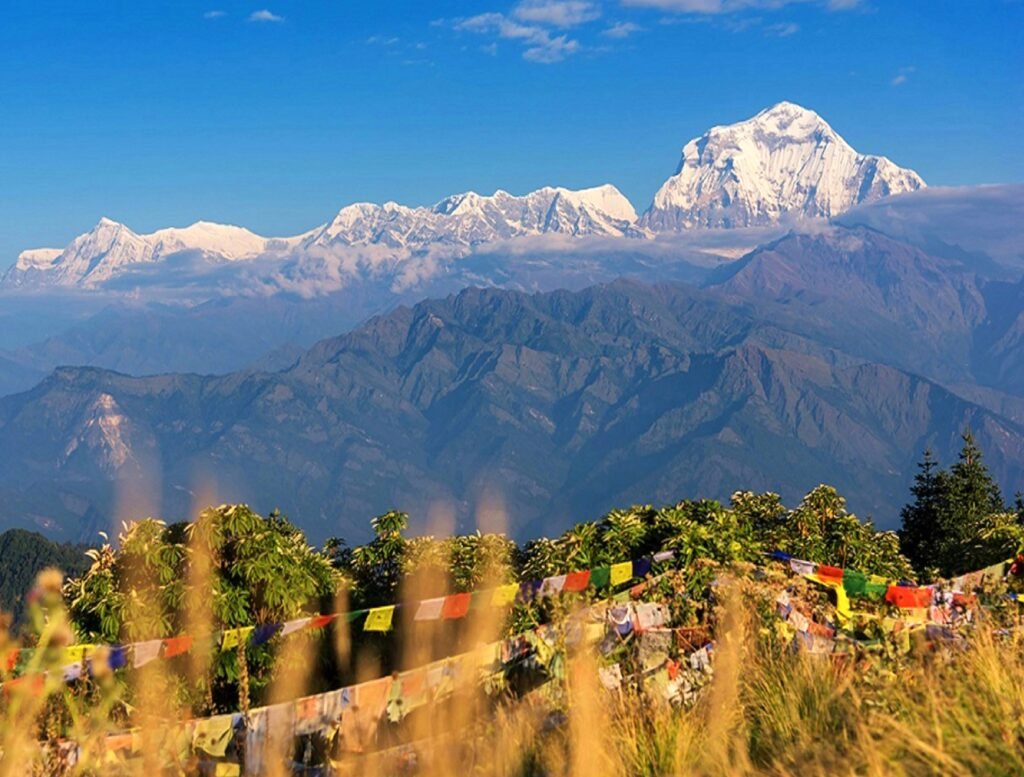

Ghorepani Poon Hill Trek
Nepal · 9 Days · Easy
Short Trek From US $830 Mantra Adventure
Trip at a Glance
Destination
Nepal
Duration
9 Days / 8 Nights
Difficulty
Easy
Activity
Trekking
Transport
Drive + Car
Group Size
Max 16 People
Accommodation
Tea House / Lodge
Meals
Breakfast, Lunch & Dinner
Max Altitude
3,210m / Poon Hill
Overview
Nepal's most celebrated sunrise panorama — rhododendron forests, Dhaulagiri, Annapurna at dawn.
Trip Highlights
- Discover the beautiful lakeside city of Pokhara - Gateway to Ghorepani Poon Hill trek
- Visit the World Peace Pagoda and enjoy panoramic mountain views
- Enjoy a wonderful boat ride on Phewa lake
- A scenic drive to Nayapool
- Witness the stunning view of sunrise from Poon Hill (3,210m)
- Capture breathtaking views of the Annapurna and Dhaulagiri ranges
- Explore the beautiful Gurung village of Ghandruk
Pricing
| Per Person | Starting From |
|---|---|
| Starting price — lower rates apply for larger groups | US $490 |
Group Discount Pricing
| Group Size | Price / Person |
|---|---|
| 1 Pax | US $700 |
| 2 - 3 Pax | US $630 |
| 4 - 7 Pax | US $580 |
| 8 - 13 Pax | US $530 |
| 14+ Pax | US $490 |
All prices are per person. Larger groups receive progressive discounts.
Day-by-Day Itinerary
Day 1
Arrival in Kathmandu (1,324m)
⛰ 1,324m
Your Poon Hill Trek begins at Tribhuvan International Airport in Kathmandu. A Mantra Adventure representative meets you on arrival and transfers you to your hotel in Thamel. After settling in, take the afternoon to explore this extraordinary city: the UNESCO-listed squares of the Kathmandu valley, the backstreets of Thamel where the smell of incense, fresh bread, and woodsmoke mingles in alleyways lined with colourful prayer flags, or the great Buddhist stupa of Boudhanath (a 20-minute taxi ride), where monks in saffron robes circle the gleaming white dome in an endless religious procession.
In the evening, your trekking guide joins you for the pre-trek briefing. The 9-day itinerary is reviewed in detail — day by day, with altitude information, what to expect at each stop, and how to prepare for the Poon Hill pre-dawn climb. Your guide inspects your gear and flags anything you should purchase before departure. Thamel has excellent trekking shops — both genuine branded gear (The North Face, Mammut, Black Diamond) and good-quality local copies at a fraction of international retail prices. If you need trekking poles, a sleeping bag liner, warmer gloves, or a headtorch, now is the time.
Welcome dinner featuring authentic Nepali food — dal bhat, gundruk soup, momos, achar (pickle), and sel roti at a traditional restaurant near your hotel.
<strong>Overnight:</strong> Hotel in Kathmandu | <strong>Meals:</strong> Welcome dinner included
Day 2
Drive Kathmandu to Pokhara (822m) — 6–7 hours by tourist bus or 25 minutes by flight
📍 Pokhara · ⛰ 822m
After breakfast, we travel to Pokhara — Nepal's adventure capital and the gateway to the Annapurna region. The choice: a comfortable tourist bus along the Prithvi Highway through the Trishuli River gorge (6–7 hours, scenic), or a 25-minute domestic flight with aerial views of the Manaslu and Annapurna ranges (strongly recommended if budget allows).
Pokhara sits at 822 metres beside Phewa Lake, with the Annapurna massif rising dramatically to the north. The sacred Machapuchare (Fishtail Peak) reflects in the lake on calm mornings — a photograph that graces the covers of countless Nepal travel guides and is, in person, even more beautiful than the images suggest.
The afternoon in Pokhara is free. Options include a boat trip on Phewa Lake (NPR 500–1,000 per hour for a small wooden rowboat), a walk along the lakeside promenade, a climb to the World Peace Pagoda (Shanti Stupa) for panoramic city and mountain views, a visit to the Gurkha Museum tracing the military history of Nepal's most famous soldiers, or simply sitting at a lakeside café with a cold Everest beer watching the mountains. Pokhara's restaurant scene is excellent — fresh lake trout, wood-fired pizza, and high-quality Nepali cuisine at bargain prices.
<strong>Overnight:</strong> Hotel in Pokhara | <strong>Meals:</strong> Breakfast
Day 3
Drive Pokhara to Nayapul (1,070m), Trek to Tikhedhunga (1,480m) — 3/4 hours walking
📍 Tikhedhunga · ⛰ 1,480m
A morning jeep transfer from Pokhara (approximately 90 minutes along the Siddhartha Highway) brings the group to Nayapul at 1,070 metres — the official starting point for both the Poon Hill Trek and the Annapurna Base Camp Trek.
At the Birethanti checkpoint, ACAP and TIMS permits are verified before the trail begins. Nayapul is a busy crossroads of trekkers, porters, mules, and motorbikes — chaotic and energetic. The trail immediately crosses a large suspension bridge over the Modi Khola river and enters the Annapurna Conservation Area on the far bank. From here, the sounds of road traffic fade and the sounds of the mountain environment take over: the rush of the river, birdsong from the subtropical forest, the creak of bamboo in the wind.
Today's walk is deliberately short — an introduction to Himalayan trekking that allows legs and lungs to adjust without overexertion. The trail follows the Modi Khola upstream through terraced farmland and small villages — stone-and-mud houses with marigolds planted in window boxes, women winnowing grain on rooftop threshing floors, children returning from school in blue uniforms. The path is stone-paved in many sections, maintained by the local communities whose teahouse income depends on keeping the trail passable.
Tikhedhunga (1,480m) is a small village perched above the river where the stone staircase begins its famous climb toward Ulleri. A cluster of teahouses offers excellent accommodation by Himalayan standards — proper beds, clean rooms, and a menu that typically includes dal bhat, pasta, pizza, and the local Nepali breakfast of chapati, egg, and tea. Settle in early, eat well, and set your alarm: tomorrow involves the trek's steepest climb.
<strong>Altitude gain:</strong> +410m | <strong>Walking time:</strong> 3-4 hours | <strong>Distance:</strong> 8km
<strong>Overnight:</strong> Teahouse in Tikhedhunga | <strong>Meals:</strong> Breakfast, Lunch, Dinner
Day 4
Tikhedhunga to Ghorepani (2,860m) — 5–6 hours
📍 Ghorepani (2,860m) · ⛰ 2,860m
This is the day that defines the Ghorepani Poon Hill Trek — a relentless, rewarding ascent that tests your legs and lungs and delivers one of the finest natural environments in Nepal.
From Tikhedhunga, the trail begins climbing immediately on a stone staircase. These are not casual steps — nearly 3,000 individual stones, each hand-set by local masons, form a continuous staircase that rises without meaningful respite for the first 600 metres to the Magar village of Ulleri (2,073m). The climb takes 1.5–2 hours depending on fitness, and it is genuinely hard — steady, steep, and unrelenting. Go slowly. Breathe through your nose. Drink water. Do not try to match the pace of porters carrying 25-kilogram loads who pass you as if the stairs were flat.
Ulleri itself is worth the climb. A large Magar village strung along a ridge at 2,073m, it has sweeping views back down the Modi Khola valley to the flat Pokhara plain and, on clear days, the shimmering distant surface of Phewa Lake. The traditional Magar stone houses, the terraced corn and millet fields on the ridgeline, and the prayer wheels at the village entrance represent a way of mountain life that has barely changed in generations.
Above Ulleri, the trail enters the rhododendron forest — and here the Poon Hill Trek reveals something genuinely exceptional. These are not ornamental rhododendrons. These are ancient trees, many over a century old, with trunks 60cm in diameter and crowns twenty metres high, their bark covered in silver-grey lichen and their branches festooned in hanging moss. Between mid-March and late April, every tree is covered in blossoms: the lower forest blazes in the deep crimson of Rhododendron arboreum, while higher species contribute pink, white, and lavender blooms in successive waves as altitude increases. In full bloom, walking through this forest is one of the most visually extraordinary experiences available anywhere in Nepal.
The forest passes through Banthanti (2,250m) and Nangethanti (2,430m) — small clusters of teahouses and stone walls in forest clearings — before the trees thin and the broad ridgeline settlement of Ghorepani (2,860m) appears. Ghorepani is a substantial village of well-run teahouses, bakeries, and shops — the main hub of the Poon Hill route, with the best accommodation quality of any overnight stop on the trek. Set your alarm for 4:30 AM. The pre-dawn climb to Poon Hill is the centrepiece of the entire trek, and the light on the mountains before direct sunrise is the finest photographic moment of the route.
<strong>Altitude gain:</strong> +1,380m | <strong>Walking time:</strong> 5–6 hours | <strong>Distance:</strong> 11km
<strong>Overnight:</strong> Teahouse in Ghorepani | <strong>Meals:</strong> Breakfast, Lunch, Dinner
Day 5
Sunrise at Poon Hill (3,210m), Trek to Tadapani (2,630m) — 5/6 hours total
📍 Tadapani (2,630m) · ⛰ 2,630m
The alarm sounds at 4:30 AM. The temperature at Ghorepani — even in the warmest months — drops to 5–10°C at night, and at 4:30 it is dark, cold, and perfectly still. Headtorches on, down jackets zipped, gloves on, and the climb begins through the frost-covered rhododendron forest toward Poon Hill.
The viewpoint is 40–50 minutes from the village — steep but manageable. By 5:15 AM the viewpoint platform is crowded with trekkers and guides facing east, watching the sky change. First comes the pre-dawn blue — a deep, luminous indigo over the eastern ridges. Then the faintest orange at the horizon, growing slowly. Then the mountains emerge from the darkness one by one as if lit from within.
Dhaulagiri (8,167m) is first — the world's seventh-highest mountain, thirty kilometres away but appearing to fill a substantial portion of the western sky. Then the Annapurna range: Annapurna I (8,091m) in the centre-right of the panorama, its south face a vertical wall of glaciated rock 4,000 metres high. Annapurna South (7,219m) and Hiunchuli (6,441m) flank it to the south, their subsidiary ridges sweeping down toward the foothills. Nilgiri (7,061m) with its striking triple summit dominates the foreground. And then — rising directly ahead in isolated, perfectly symmetrical splendour — Machapuchare (6,993m), the Fishtail Peak. Its double summit, rendered sacred by the Nepal government (no ascent permitted), appears from Poon Hill as an impossibly perfect spire.
When the first direct sunlight strikes the Annapurna summits, the change is instantaneous and total. One moment they are cold grey stone and ice. The next moment they are blazing gold, then brilliant white. The Himalayan alpenglow — the colour of new fire on ancient rock — lasts only minutes before the full daylight normalises everything. Photograph it. But also, for at least some of those minutes, put the camera down and simply watch.
After photos and quiet celebration on Poon Hill, we descend to Ghorepani for breakfast. The meal after the climb is always particularly satisfying — strong Nepali tea, eggs, porridge, and fresh chapati while the mountains glow in full morning light.
The trail then continues east from Ghorepani through the rhododendron forest to Deurali (2,960m), where the path begins to descend through increasingly dense oak and magnolia forest toward Tadapani (2,630m) — a ridgetop settlement with close-up views of Annapurna South directly to the north. Tadapani's teahouses are small and atmospheric, with the mountain appearing so close above the village that it seems almost possible to touch the glacier face.
<strong>Max altitude:</strong> 3,210m (Poon Hill) | <strong>Overnight altitude:</strong> 2,630m | <strong>Walking time:</strong> 5-6 hours total
<strong>Overnight:</strong> Teahouse in Tadapani | <strong>Meals:</strong> Breakfast, Lunch, Dinner
Day 6
Tadapani to Ghandruk (1,940m) — 3 - 4 hours
📍 Ghandruk (1,940m) · ⛰ 1,940m
A short, beautiful morning walk from Tadapani's ridge descends through old-growth rhododendron and oak forest with constant mountain views — Annapurna South and Machapuchare framing the northern horizon throughout the descent. The trail passes through Gurjung before dropping to the broad valley floor and the beginning of Ghandruk, one of the most beautiful villages in Nepal.
Ghandruk (1,940m) is a large, prosperous Gurung settlement of terraced stone houses built on a series of descending ridges, connected by stone-paved pathways and stone-walled lanes. The architecture is traditional Gurung: dark stone walls, carved wooden window frames, flat roofs used for drying grain in autumn and socialising in summer. Marigold, geranium, and rose gardens fill the spaces between houses.
The Gurung people of Ghandruk have a fascinating history. Their martial tradition led generations of men to serve in the British Gurkha regiments — the famous fighting force whose courage the British army has relied upon since 1815. The Gurung Museum in Ghandruk's upper village tells this story with impressive collections of Gurkha memorabilia, traditional dress, agricultural tools, and musical instruments. The museum is run by the local community and provides an authentic window into Gurung culture that no amount of trekking alone can deliver.
From Ghandruk's upper teahouses, the view of Annapurna South and Machapuchare is extraordinary — the peaks rise directly above the village with no intervening ridgeline, creating a perspective that makes them appear impossibly close and tall. Many trekkers name Ghandruk — rather than Poon Hill — as the highlight of the entire trek for precisely this reason: it is the closest inhabited point to the main Annapurna peaks on any standard trekking route.
The afternoon in Ghandruk is free. This is a place to walk slowly, photograph extensively, and talk to the local people. The teahouses here are among the best on the entire Poon Hill circuit.
<strong>Overnight:</strong> Teahouse in Ghandruk | <strong>Meals:</strong> Breakfast, Lunch, Dinner
Day 7
Ghandruk to Nayapul, Drive to Pokhara — 3 hours trek + 90 minutes drive
📍 Pokhara · ⛰ 822m
The final trekking day is a pleasant, gradual descent from Ghandruk through terraced farmland along the Modi Khola river valley to Nayapul. The character of the landscape softens significantly from the high-altitude forest world of the preceding days — subtropical crops, roadside market stalls, and the sounds of a busier, lower-altitude world mark the return to the valley. The trail follows the river closely for much of the descent, with views of the Modi Khola's blue-green water rushing through a series of small gorges.
At Birethanti, the ACAP permit checkpoint records your exit from the Conservation Area. A jeep meets the group at Nayapul for the 90-minute drive back to Pokhara, arriving by early afternoon. The Pokhara hot shower — unlimited hot water, proper pressure, the ability to wash hair without using a bucket — is one of the most anticipated moments of any Nepal trek descent.
The rest of the afternoon is free. Pokhara's lakeside is at its most beautiful in the late afternoon light. Rent a kayak on Phewa Lake for an hour, visit the Begnas Lake viewpoint, browse the lakeside shops for genuine silver Tibetan jewellery and handmade ceramics, or simply sit and watch Machapuchare — the mountain you've been walking toward for six days — reflect in the still surface of the lake. Celebratory dinner at one of Pokhara's best restaurants this evening — your guide joins for a farewell meal, and tips for the guide and porter are traditionally presented at this point.
<strong>Overnight:</strong> Hotel in Pokhara | <strong>Meals:</strong> Breakfast, Lunch, Dinner
Day 8
Drive or Fly Pokhara to Kathmandu — 6–7 hours or 25 minutes
📍 Kathmandu · ⛰ 1,324m
Return to Kathmandu by tourist bus or domestic flight. Arriving by early afternoon, the rest of the day is free for last-minute shopping and sightseeing in the Kathmandu valley. Thamel's shops offer excellent souvenirs: pashmina shawls and scarves (Nepal is the world's finest cashmere and pashmina producer), Tibetan singing bowls used for meditation, hand-knotted wool carpets in traditional Tibetan designs, thangka paintings on cotton canvas depicting Buddhist deities, and handmade Lokta paper notebooks and journals.
A visit to Boudhanath or Pashupatinath in the late afternoon is worthwhile — Pashupatinath in particular is most atmospheric at sunset when Hindu cremation ceremonies take place on the ghats of the Bagmati River, attended by sadhus (holy men) covered in ash and ochre paint.
<strong>Overnight:</strong> Hotel in Kathmandu | <strong>Meals:</strong> Breakfast
Day 9
Final Departure from Kathmandu
Your Ghorepani Poon Hill Trek with Mantra Adventure concludes today. Our representative meets you at the hotel and transfers you to Tribhuvan International Airport approximately three hours before your international departure. As you fly out of Kathmandu — and if the weather is clear, the Himalayan skyline appears one final time through the aircraft window — you carry home the sunrise you watched from Poon Hill, the rhododendron forest through which you walked, and the hospitality of the Gurung people who made the teahouses feel like home.
We hope to welcome you back for a longer Himalayan adventure — the Annapurna Base Camp Trek, the Annapurna Circuit, or the Everest Base Camp Trek are natural progressions. The mountains are always there.
<strong>Meals:</strong> Breakfast
What's Included & Excluded
✓ Included
- Airport pick-up and drop-off
- Domestic transport per itinerary
- All accommodation during the trip
- All meals as specified in the itinerary
- Experienced English-speaking certified guide
- Porter (1 per 2 trekkers, max 15kg)
- All trekking permits and national park fees
- TIMS card
- Mantra Adventure duffel bag
- First aid kit
✗ Not Included
- International flights
- Nepal visa (USD 30-100 on arrival)
- Personal travel insurance (mandatory)
- Meals in Kathmandu/Pokhara
- Accommodation in Kathmandu (available on request)
- Alcoholic beverages, hot showers, personal items
- Personal trekking gear
- Tips for guide and porters
Travel Tips & Useful Information
➤ What is the best season for this trip?
<strong>October and November — Best mountain views</strong>
Post-monsoon clarity produces the sharpest mountain views of any season. October is the busiest month on all Nepal trekking routes — teahouses fill up and the Poon Hill viewpoint is crowded on mornings. November is equally clear with fewer trekkers and progressively cooler temperatures. Both months are excellent.
<strong>March and April — Best rhododendron season</strong>
This is the most beautiful version of the Poon Hill Trek. The rhododendron forest blooms progressively from March through April, reaching peak coverage in the last week of March and first two weeks of April. The combination of flowering forest and clear mountain views makes this arguably the finest two-week window for the route. April is busier than March.
<strong>December and January — Quiet and cold</strong>
Excellent for solitude. Night temperatures at Ghorepani drop below 0°C in January, and the Poon Hill summit in pre-dawn darkness can feel extremely
cold. The forest is bare but dramatic, and the mountain views are superb on clear days. Good for experienced trekkers seeking solitude and winter mountain photography.
<strong>February — Early spring</strong>
Transitional month. The lower-altitude rhododendrons begin to bloom by late February. Good conditions, moderate crowds. A good choice for those who want some rhododendron colour without the busy April period.
<strong>May — Late Spring</strong>
Warm at lower elevations, beautiful in the forest (upper-altitude rhododendrons still blooming in early May), quiet on the trail. Pre-monsoon afternoon cloud can reduce summit views. A good budget option — teahouse prices drop slightly in the shoulder months.
<strong>June–September — Monsoon (avoid)</strong>
Heavy rainfall makes the lower trail wet and leech-infested. The Poon Hill viewpoint is usually obscured by monsoon cloud. We do not recommend the Ghorepani Poon Hill Trek during the core monsoon months of July and August.
➤ How difficult is the Ghorepani Poon Hill Trek?
This trip is rated Easy. Suitable for beginners with basic fitness — walking 3-4 times per week for 4-6 weeks is adequate. No technical experience needed.
➤ Do I need a visa?
Most nationalities get Nepal visa on arrival at Kathmandu airport for USD 30 (30 days). Indian nationals do not require a visa.
➤ What permits are required?
Annapurna Conservation Area Permit (USD 30) + TIMS card. Arranged by Mantra Adventure. No extra hassle for you.
➤ What is included in the price?
Included: Airport transfers; domestic flights/transport per itinerary; all trek accommodation; all meals during trek; English-speaking guide; porters (1 per 2 trekkers); all trekking permits; Mantra Adventure duffel bag. Not included: International flights; Nepal visa; personal travel insurance (mandatory); personal gear; tips.
➤ What fitness level is required?
For Ghorepani Poon Hill Trek (Easy): Regular walking or swimming 3×/week for 6 weeks is sufficient. You should be comfortable walking 5-6 hours on uneven terrain.
➤ Is altitude sickness a concern?
Maximum altitude is 3,210m / Poon Hill. Altitude sickness is a real risk above 3,500m. Our itinerary includes acclimatisation days and our guides carry supplemental oxygen. Diamox can be taken as prophylaxis — consult your doctor. Emergency evacuation insurance is mandatory.