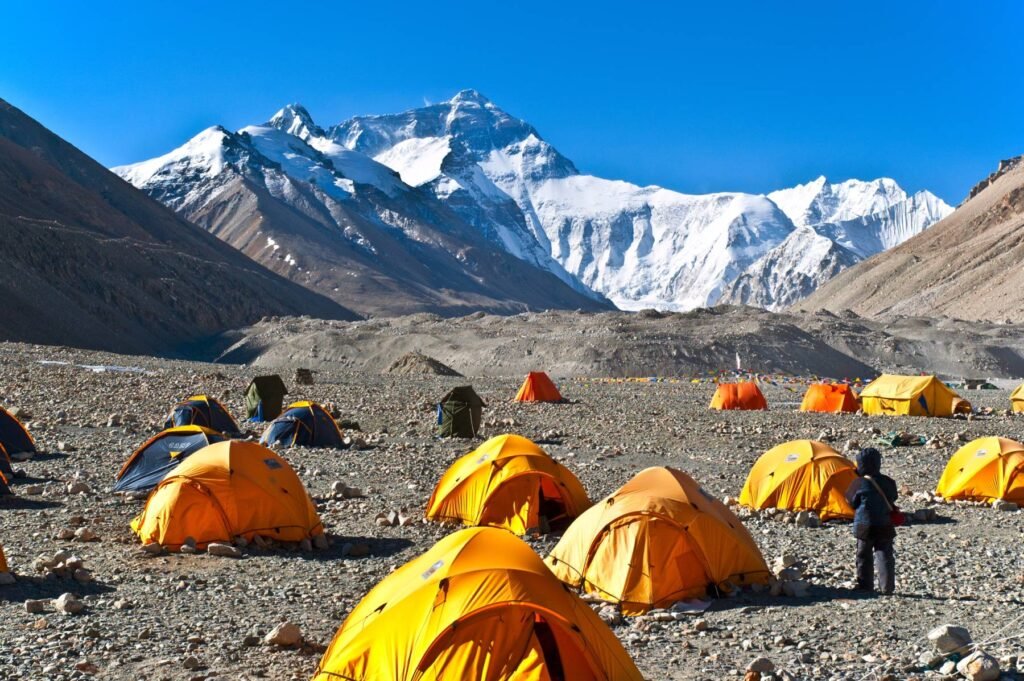

Everest Base Camp Trek
Nepal · 14 days · Moderate
Classic Trek From US $1,530 Mantra Adventure
Trip at a Glance
Destination
Nepal
Duration
14 days
Difficulty
Moderate
Activity
Trekking
Transport
Flight KTM-Lukla + Car
Group Size
Max 16 People
Accommodation
Tea House / Lodge
Meals
Breakfast, Lunch & Dinner
Max Altitude
5,545m / Kala Patthar
Overview
Stand at the foot of the world's highest mountain — the trek of a lifetime through the Khumbu.
Trip Highlights
- Scenic flight to Tenzing-Hillary Airport, Lukla (2,860m)
- Explore traditional Sherpa villages and cultures
- Walk through a UNESCO World heritage site( Sagarmatha national park)
- Panoramic views of Mt. Everest and other mountains
- Reach the world's most famous and iconic Everest base camp (5,364m)
- Hike to Kala Patthar (5,545m) for the closest view of Mt Everest
- Visit Tengboche Monastery
- Experience the life changing adventure
Pricing
| Per Person | Starting From |
|---|---|
| Starting price — lower rates apply for larger groups | US $1,199 |
Group Discount Pricing
| Group Size | Price / Person |
|---|---|
| 1 Pax | US $1,390 |
| 2 - 3 Pax | US $1,330 |
| 4 - 7 Pax | US $1,290 |
| 8 - 13 Pax | US $1,250 |
| 14+ Pax | US $1,199 |
All prices are per person. Larger groups receive progressive discounts.
Day-by-Day Itinerary
Day 1
Arrival in Kathmandu
📍 Kathmandu · ⛰ 1,324m
Welcome to Nepal, the gateway to the Himalayas, where your Everest Base Camp Trek begins the moment you land at Tribhuvan International Airport in Kathmandu. A Mantra Adventures representative holding our company signboard will meet you outside the arrivals hall and transfer you to your hotel in Thamel, the vibrant tourist quarter at the heart of the city.
After checking in and freshening up, take some time to recover from your international flight and adjust to Nepal's timezone. In the evening, your trekking guide will join you at the hotel for a detailed pre-trek briefing, where we review the 14-day Everest Base Camp itinerary, discuss altitude safety protocols, go over packing essentials, and answer any questions about the Khumbu region.
This is also when we inspect your gear — if you're missing anything, we'll point you to reliable trekking shops in Thamel for last-minute purchases such as down jackets, sleeping bags, trekking poles, or a duffel bag. Enjoy a welcome dinner featuring authentic Nepali cuisine, then rest well — tomorrow the real adventure begins with your scenic flight to Lukla, one of the world's most thrilling mountain airports. Overnight at your hotel in Kathmandu on a bed-and-breakfast basis.
Day 2
Fly to Lukla (2,840m) and Trek to Phakding (2,610m)
📍 Phakding
An early morning transfer takes you to the domestic terminal for one of the most exhilarating flights in the world — the 35-minute scenic flight to Tenzing-Hillary Airport in Lukla. As the small twin-otter aircraft banks between towering ridgelines and lands on the short, sloped runway at 2,840 metres, you'll catch your first close-up views of the snow-capped Himalayan giants. After meeting your porters and reorganising gear at Lukla, the Everest Base Camp Trek officially begins.
The trail descends gently through pine forest towards the Dudh Koshi River, passing through the Sherpa villages of Cheplung and Ghat where colourful prayer flags, spinning prayer wheels, and carved mani stones signal your entry into Buddhist Khumbu culture. Today's three-to-four-hour walk is purposely kept short so your body can start acclimatising to the elevation. You'll cross your first suspension bridge festooned with fluttering prayer flags before following the river's course to Phakding, a small riverside village at 2,610 metres where teahouses line the main trail.
After settling into your lodge, take a short acclimatisation stroll to the nearby Rimishung Monastery or the Pema Choling Gompa for an introduction to the Tibetan Buddhist traditions that shape daily life in the Khumbu. Overnight at a teahouse in Phakding.
Day 3
Phakding to Namche Bazaar (3,440m)
📍 Namche Bazaar
Today is a significant day on the Everest Base Camp Trek — you climb into the high Khumbu and reach Namche Bazaar, the legendary Sherpa capital at 3,440 metres. Leaving Phakding after breakfast, the trail follows the Dudh Koshi River upstream through dense pine and rhododendron forest, crossing several dramatic suspension bridges along the way.
You pass through the villages of Benkar, Chumoa, and Monjo, where you officially enter Sagarmatha National Park — a UNESCO World Heritage Site protecting Mount Everest and the surrounding Himalayan peaks. Your guide handles the permit check-in at the park entrance. Beyond Jorsale, the trail crosses the highest and most famous suspension bridge at the confluence of the Dudh Koshi and Bhote Koshi rivers — the so-called Hillary Bridge strung high above the rushing glacial waters.
The real challenge begins here: a steep two-hour ascent through forest and rocky switchbacks that gains nearly 600 metres of elevation. About halfway up, weather permitting, you'll catch your very first glimpse of Mount Everest (8,848m) framed between Lhotse and Nuptse — a moment most trekkers never forget. Arriving in Namche Bazaar in the early afternoon, you'll find a vibrant horseshoe-shaped town with cafés, bakeries, trekking shops, and Sherpa-run lodges terraced into the mountainside. Overnight at a lodge in Namche Bazaar.
Day 4
Acclimatisation Day — Namche Bazaar
📍 Namche Bazaar
Acclimatisation is the single most important factor for a successful Everest Base Camp Trek, and today your body adjusts to the thinning mountain air before climbing higher. Following the golden rule of "climb high, sleep low," we take a short acclimatisation hike up to Hotel Everest View (3,880m) — one of the highest luxury hotels in the world.
The climb takes about two hours and rewards you with panoramic views of Mount Everest, Lhotse, Ama Dablam, Thamserku, and Kwangde. On clear mornings the peaks appear so close you feel you could touch them. On the way up, we stop at the Syangboche airstrip and, if time allows, visit the Sherpa village of Khumjung — home to the famous Hillary School founded by Sir Edmund Hillary, and the Khumjung Monastery that houses what locals claim is the scalp of a yeti.
Back in Namche by early afternoon, spend the rest of the day exploring this fascinating town: visit the Sherpa Culture Museum and Sagarmatha National Park Visitor Centre for insight into mountaineering history, or browse the well-stocked shops selling everything from yak-wool hats and prayer flags to trekking gear and fresh bakery treats. Enjoy a coffee at an Irish-style pub — at 3,440m, arguably the highest one in the world. Overnight at a lodge in Namche Bazaar.
Day 5
Namche Bazaar to Tengboche (3,860m)
📍 Tengboche
After breakfast, we leave Namche Bazaar and follow a scenic high-altitude trail that contours around the mountainside, offering constant views of the towering Khumbu peaks. Today's walk begins with a gentle climb out of Namche before the trail flattens and opens into one of the most beautiful sections of the entire Everest Base Camp Trek.
To your left, the sacred peak of Ama Dablam (6,812m) rises like a perfectly sculpted pyramid — for many trekkers, this is the defining image of the Khumbu. After about two hours, you reach the small settlement of Kyangjuma, then descend steeply through rhododendron and blue pine forest to Phunki Thenga at the Dudh Koshi river, where we stop for lunch. The afternoon brings a demanding two-hour ascent of roughly 600 metres through fragrant juniper and rhododendron forest to reach Tengboche, home to the largest and most famous monastery in the Khumbu.
The 360-degree panorama from the monastery grounds is breathtaking — Everest, Lhotse, Nuptse, Ama Dablam, Kangtega, and Thamserku all visible in one sweep. If you arrive in time for the afternoon puja (prayer ceremony), the monks welcome respectful visitors to observe the chanting, drums, and long horns that have echoed here for centuries. Overnight at a teahouse in Tengboche.
Day 6
Tengboche to Dingboche (4,410m)
📍 Dingboche
An early breakfast at Tengboche sets you up for one of the most memorable days of the Everest Base Camp Trek, as the landscape transitions from forested valleys to open alpine terrain. Leaving the monastery behind, the trail descends gradually through rhododendron forests to Deboche, then crosses the Imja Khola on a steel suspension bridge.
The path now climbs steadily past the village of Pangboche (3,985m) — the oldest Sherpa settlement in the region, with its own ancient gompa that traditionally houses a supposed yeti relic. From Pangboche, you have the option to visit the Pangboche Monastery before continuing upward. The trail levels out as it follows the Imja Valley, with Ama Dablam dominating the skyline behind you. Junipers and dwarf shrubs replace the pine forest as you cross the treeline at around 4,000 metres.
After a small wooden bridge at Somare, the final climb leads to Dingboche, a picturesque village of stone walls and small potato fields at 4,410 metres. At this altitude, the air noticeably thins and temperatures drop sharply after sunset. Dingboche sits in a broad glacial valley with dramatic views of Lhotse, Island Peak, and the fluted ice walls of Ama Dablam's south face. Spend the evening hydrating and resting — tomorrow's acclimatisation day is essential for the higher trek ahead. Overnight at a teahouse in Dingboche.
Day 7
Acclimatisation Day — Dingboche
📍 Dingboche
A second acclimatisation day is crucial before pushing further into the high Khumbu, and Dingboche offers one of the best vantage points on the entire Everest Base Camp Trek for a "climb high, sleep low" excursion. After a relaxed breakfast, we hike up to Nangkartshang Peak (5,083m), the rocky promontory rising directly above the village. The ascent takes three to four hours at a steady, unhurried pace — the altitude demands you go slowly and pause often to catch your breath.
Reaching the top rewards you with a spectacular 360-degree panorama: Mount Makalu (8,485m), the world's fifth-highest peak, appears to the east, while Lhotse, Island Peak, Ama Dablam, Taboche, and Cholatse frame the horizon in every direction. On clear days you can even glimpse the Kangshung Face of Mount Everest peeking from behind Lhotse. The hike also serves as excellent preparation for the higher altitudes ahead, helping your body produce more red blood cells and adjust to the reduced oxygen at 5,000+ metres.
After descending back to Dingboche by midday, enjoy a long lunch, stay well hydrated, and take it easy for the rest of the afternoon. Some trekkers spend the downtime reading, playing cards, writing journals, or chatting with other hikers in the teahouse's warm dining room. Overnight at a teahouse in Dingboche.
Day 8
Dingboche to Lobuche (4,940m)
📍 Lobuche
Today's trek takes you deep into the high Himalayan landscape, with sweeping views that define the final stretch of the Everest Base Camp Trek. After breakfast at Dingboche, we begin with a gentle ascent past the ancient village of Dusa, then contour along a high ridge above the Pheriche valley. The scenery becomes increasingly dramatic as the treeline disappears completely and the terrain turns to a stark, windswept moonscape of moraine, boulders, and glacial streams.
After about two hours you reach Thukla (Dugla) at 4,620m, where a small cluster of teahouses offer a hot lunch break. The next section is both steep and spiritually moving: a demanding 45-minute climb up the Thukla Pass brings you to the Thukla Memorial, a hauntingly beautiful collection of stone chortens and cairns honouring climbers who have lost their lives on Everest and surrounding peaks — including legends like Scott Fischer, Rob Hall, and Babu Chiri Sherpa.
Take a moment here to reflect on the magnitude of the mountains and the courage of those who have challenged them. From the memorial, the trail levels out and follows the edge of the Khumbu Glacier's lateral moraine to Lobuche, where stone lodges cluster beneath the towering walls of Lobuche Peak (6,119m). Temperatures are freezing at night — dress warmly. Overnight at a teahouse in Lobuche.
Day 9
Lobuche to Gorak Shep (5,180m) and Visit Everest Base Camp (5,364m)
📍 Gorak Shep
This is the day you've been preparing for — you reach Everest Base Camp at 5,364 metres. The trek from Lobuche to Gorak Shep takes about three hours along the rocky lateral moraine of the Khumbu Glacier, with constantly shifting views of Pumori, Nuptse, and the icy spires of the Khumbu Icefall. The trail is uneven and rocky rather than steep, but the thin air makes every step deliberate.
After reaching Gorak Shep (5,180m) — a tiny, weather-beaten settlement of basic teahouses that serves as the highest permanent stop on the trek — we drop off our packs, enjoy a quick lunch, and set out for the final push to Everest Base Camp itself. The three-hour round trip to EBC is arguably the most iconic walk in Himalayan trekking. The path winds across the Khumbu Glacier's frozen moraine, past towering seracs and crevassed ice, until you reach the collection of coloured prayer flags, cairns, and memorial plaques that mark Base Camp at 5,364m.
During the spring climbing season (April–May) you'll see the colourful tent city of mountaineers preparing to summit Everest. Take your time here — snap photos at the famous rock, feel the enormity of the Khumbu Icefall rising behind, and absorb the achievement. Return to Gorak Shep as dusk falls. Overnight at a teahouse in Gorak Shep.
Day 10
Gorak Shep to Kala Patthar (5,545m), then Descend to Pheriche (4,240m)
📍 Pheriche
Today is arguably the most visually rewarding morning of the entire Everest Base Camp Trek. Before dawn, we wake early — around 4:30 AM — and begin the steep climb up Kala Patthar (5,545m), the rocky ridge that offers the closest unobstructed view of Mount Everest's southwest face. The ascent is tough: roughly 400 metres of elevation gain through loose scree and boulders in freezing, thin air, taking two to three hours.
But as the first rays of sunrise strike the summit of Everest and turn the peak gold, every hard step is forgotten. From the top of Kala Patthar you stand at the highest point of the entire trek, with Everest, Nuptse, Pumori, Lhotse, and the Khumbu Glacier laid out in a breathtaking 360-degree panorama. After plenty of photos and silent awe, we descend carefully back to Gorak Shep for a late breakfast.
The rest of the day is downhill — always easier on your lungs — as we retrace our steps to Lobuche, then continue down to Pheriche (4,240m), a broad grassy valley with the Himalayan Rescue Association Aid Post staffed by volunteer doctors. Arriving in Pheriche in the late afternoon, your body noticeably relaxes as the oxygen returns. Enjoy a hearty dinner and rest well. Overnight at a teahouse in Pheriche.
Day 11
Pheriche to Namche Bazaar (3,440m)
📍 Namche Bazaar
The descent begins in earnest today, retracing your steps back through the stunning Khumbu valley with a wonderfully different perspective. After breakfast at Pheriche, we follow the trail down past Orsho and Shomare, back across the Imja Khola river, and climb briefly to revisit Pangboche village. A steady descent through juniper and rhododendron forest brings us back to Tengboche for an early lunch, where you can once again admire the monastery and, if lucky, attend the afternoon prayer ceremony.
From Tengboche, the long downhill to Phunki Thenga along the Dudh Koshi is steep but rewarding, particularly in spring (April–May) when the rhododendrons burst into spectacular red and pink blooms along the trail. After crossing the river, the final stretch involves a gentle climb back up to the high trail, contouring around the mountainside with familiar views of Ama Dablam and Thamserku.
We reach Namche Bazaar by late afternoon. Back at lower altitude, many trekkers notice an immediate improvement in energy, appetite, and sleep quality. Celebrate your successful summit of Kala Patthar with a hot shower, a steak or pizza at one of Namche's legendary bakery-cafés, and perhaps a hard-earned drink. Reflect on how far you've come — both in kilometres and in vertical metres conquered. Overnight at a lodge in Namche Bazaar.
Day 12
Namche Bazaar to Lukla (2,840m)
📍 Lukla
The final trekking day of your Everest Base Camp Trek takes you back through the lower Khumbu forests to Lukla, where your Himalayan adventure began nearly two weeks ago. After breakfast in Namche, we descend the steep switchbacks back down to the Hillary Bridge over the Dudh Koshi — a thrilling crossing that looks even more dramatic on the way down. Continuing through the Sagarmatha National Park gate at Jorsale, we officially leave the protected Everest region.
The trail undulates along the riverbank through pine forests, passing Monjo, Benkar, and Phakding — stops that feel nostalgically familiar after your outbound journey. Stop for lunch at Phakding or Toktok before continuing on the steady uphill climb of the afternoon section to Cheplung and finally Lukla. The walk takes six to seven hours in total, longer than expected because the trail gains elevation back to Lukla.
Arriving in Lukla by mid-afternoon, celebrate the successful completion of your trek with your guide and porters — this is traditionally the evening when trekking teams share a farewell dinner, often with cold drinks, music, and tips exchanged. Reflect on the incredible journey you've completed: from arriving in Kathmandu to standing at Everest Base Camp and Kala Patthar, all in under two weeks. Overnight at a lodge in Lukla.
Day 13
Fly from Lukla to Kathmandu
📍 Kathmandu
Your final morning in the Himalayas begins with an early wake-up for the 35-minute scenic flight from Lukla back to Kathmandu. Because of Lukla's challenging weather and short runway, flights operate only in the clearest morning hours and occasionally face delays — sometimes flights are re-routed via Ramechhap during peak trekking seasons (March–May and October–November). Your guide will manage all airport logistics. If the flight departs on schedule, you'll touch down in Kathmandu by mid-morning where our team meets you at the domestic terminal and transfers you back to your hotel in Thamel.
The rest of the day is yours to relax and enjoy the city at your own pace. A hot shower at the hotel feels like the greatest luxury in the world after two weeks of teahouses. You might treat yourself to a well-deserved spa treatment, a massage, or simply spend the afternoon shopping for souvenirs in Thamel — pashmina shawls, singing bowls, prayer flags, Buddhist thangka paintings, or handmade Nepali paper goods make meaningful gifts. In the evening, we host a celebratory farewell dinner at a traditional Nepali restaurant featuring authentic dal-bhat, momos, and cultural dance performances — a fitting end to your Everest Base Camp Trek. Your guide will coordinate your airport transfer for the following morning. Overnight at a hotel in Kathmandu.
Day 14
Final Departure from Kathmandu
📍 Kathmandu
Your Everest Base Camp Trek with Mantra Adventures comes to a close today. A Mantra Adventures representative will meet you at the hotel lobby approximately three hours before your international flight and transfer you safely to Tribhuvan International Airport for departure. As you leave Kathmandu, you carry home not just memories, photos, and a sense of incredible physical achievement but also a deeper connection to the Sherpa people, Buddhist culture, and the raw majesty of the world's highest mountain range. Many of our trekkers tell us the Everest Base Camp experience is genuinely life-changing — a journey that recalibrates what's possible and leaves a lasting impression long after they return home.
We'd love to welcome you back to Nepal for another adventure in the future — the Annapurna Circuit, a luxury Everest Base Camp heli-trek, or perhaps the challenging Three Passes circuit combining Cho La, Renjo La, and Kongma La. Wherever you go next, we're honoured you chose Mantra Adventures for this unforgettable trek. If you enjoyed your experience, sharing a review on TripAdvisor or Google would mean a lot to our team and helps fellow adventurers plan their own Himalayan journey. Safe travels, and Namaste — until we meet again in the mountains. Your adventure concludes with our gratitude and well-wishes.
What's Included & Excluded
✓ Included
- Airport pick-up and drop-off
- Domestic transport per itinerary
- All accommodation during the trip
- All meals as specified in the itinerary
- Experienced English-speaking certified guide
- Porter (1 per 2 trekkers, max 15kg)
- All trekking permits and national park fees
- TIMS card
- Mantra Adventure duffel bag
- First aid kit
✗ Not Included
- International flights
- Nepal visa (USD 30-100 on arrival)
- Personal travel insurance (mandatory)
- Meals in Kathmandu/Pokhara
- Accommodation in Kathmandu (available on request)
- Alcoholic beverages, hot showers, personal items
- Personal trekking gear
- Tips for guide and porters
Travel Tips & Useful Information
➤ Flights to Lukla during the main trekking seasons
Most people assume they fly to Lukla from Kathmandu. In the busy months, you probably won't. From roughly late March to May, and again from late September to November, Lukla flights shift to Manthali Airport in Ramechhap. This isn't a weather decision.
TIA (Tribhuvan international airport) simply cannot absorb the number of Everest flights those months bring, so the whole operation moves out of the valley to keep it running. If you're staying in Kathmandu during those periods, your trek begins with a road journey rather than a flight.
<h3>What about flights from Kathmandu?</h3>
Outside the Ramechhap windows, Lukla flights usually run straight from TIA in Kathmandu. That's the shorter, easier version: a 35-minute flight and no night drive.
The catch is that the arrangement gets revised season to season, and sometimes at shorter notice than that. We confirm your departure airport when we send your flight details. Please don't book connecting travel around an assumption.
<h3>The journey from Kathmandu to Ramechhap</h3>
Manthali is four to five hours away on mountain road. Lukla flights go early. Put those two facts together and you get a hotel pickup somewhere between 1am and 2am. There's no clever way around it. It's the part of the trip nobody arrives expecting, and the part everyone remembers afterwards. Sleep on the bus if you can manage it.
We arrange the vehicle and your guide travels with you, so you aren't working anything out at that hour. The payoff is real: you land in Lukla mid-morning and walk to Phakding the same day, exactly as the itinerary promised. Nothing slips.
<h3>Why Lukla flights are scheduled so early</h3>
Lukla's airstrip sits on a shelf at 2,860m with a mountainside at one end and a drop at the other. There is no instrument approach and no second attempt. Pilots need to see the valley.
Cloud builds through the morning, wind picks up after midday, and by early afternoon the window has usually closed. Flying early isn't a scheduling preference. It's the only reliable part of the day.
<h3>Flight delays and cancellations</h3>
Lukla flights are weather-dependent, and delays are normal rather than exceptional. Losing a day to weather is a routine part of trekking in this region, in any season. A flight gets held when visibility, wind or cloud fall outside what's safe.
That call is made by the operator and the tower, not by us, and it isn't negotiable. If you're delayed, we get you onto the next available flight and adjust the itinerary where the schedule leaves room. Most delays cost hours rather than days.
<h3>Weather at Lukla</h3>
At 2,860m, Lukla makes its own weather and changes it quickly. A clear morning can turn to cloud in twenty minutes, and fog sits in the valley long after the ridges above have cleared. Here's what catches people out. Conditions in Kathmandu tell you nothing about conditions in Lukla.
You will stand on a sunlit apron in Kathmandu and be told Lukla is closed. It happens the other way round just as often, which is why flights sometimes leave into what looks like bad weather. Even in peak spring and autumn, nobody gets a guaranteed flying day. Clear stretches are common. Unbroken ones aren't.
<h3>Allow some flexibility</h3>
Leave at least one spare day before your international flight home. This is the single most useful thing you can do while planning, and it costs you nothing if the weather holds. The trekkers who get hurt are the ones who booked a flight home for the day after they're due back in Kathmandu.
When the weather closes in, their only remaining option is a helicopter out of Lukla, which runs upwards of USD 500 a seat. Insurance generally won't cover it, because flying out for convenience isn't an emergency evacuation. The mountains don't run to your schedule. One buffer day is usually the difference between an inconvenience and a very expensive problem.
<h3>What to expect on the trail</h3>
The route follows the Dudh Koshi north through Sherpa country. Suspension bridges strung with prayer flags, pine and rhododendron forest low down, then a hard transition above Dingboche where the trees stop and everything turns to rock, ice and sky. Namche Bazaar at 3,440m is the hub of the Khumbu, built in a natural amphitheatre, with bakeries, gear shops and your first proper view of Everest.
Tengboche has the region's most important monastery, and if you time the afternoon prayers you'll hear them with Ama Dablam filling the window behind. Dingboche is where the landscape opens out and the altitude starts to be felt. Gorak Shep at 5,164m is the last settlement, and it is a bleak one. Everest itself stays modest for much of the walk, hidden behind Nuptse.
Ama Dablam is the peak that stops conversations. The view most people carry home is from Kala Patthar at dawn, when the light reaches Everest's summit pyramid before it reaches anything else. The trail gets rougher and the air thinner with every day. That's why the acclimatisation days sit where they do.
<h3>Accommodation</h3>
You sleep in teahouses the whole way. Twin rooms, thin mattresses, blankets supplied. Below Namche the lodges are genuinely comfortable and some have attached bathrooms and reliable hot water. Above Dingboche things get basic. Shared squat toilets, plywood walls, no heating outside the dining room, and a yak-dung stove that gets lit in the evening and not before.
Rooms are for sleeping in; everyone lives in the dining room. Bring a four-season sleeping bag rather than relying on lodge blankets, and a set of earplugs. The walls are thin and the altitude makes people restless.
<h3>Food and drinks</h3>
The menus are broader than you'd expect at that altitude. Dal bhat, momos, noodles, pasta, soups, potatoes, eggs, porridge, and Tibetan bread that is worth the wait. Order the dal bhat on long days. Refills are free, it's built for exactly this kind of effort, and it's cooked fresh in volume rather than sitting around.
Appetite usually drops above 4,000m, so eat when you can even if you don't feel like it. Drink three to four litres a day. Refill from teahouse boiled water, or treat tap water with tablets or a SteriPen. Skip the plastic bottles. They're expensive above Namche and the region has no way of disposing of them.
<h3>What you'll spend on the trail</h3>
Budget roughly USD 15–25 a day for things outside your package. Hot showers, charging your phone, WiFi and bottled drinks are all charged separately, and every price climbs with the altitude because everything arrives on a porter's back or a yak. Bring enough cash from Kathmandu for the entire trek.
The last dependable ATM is in Namche and it is frequently out of service, out of notes, or both. Above it there is nothing. Tipping is customary at the end of the trek. As a guide, budget around USD 10–15 a day for your guide and USD 8–10 for your porter, split across the group.
➤ How difficult is the Everest Base Camp Trek?
This trip is rated Challenging. Requires good fitness and ideally prior high-altitude or multi-day trekking experience. Begin cardio and hiking training 3 months before departure.
➤ Do I need a visa?
Most nationalities get Nepal visa on arrival at Kathmandu airport for USD 30 (30 days). Indian nationals do not require a visa.
➤ What permits are required?
Sagarmatha National Park (USD 30) + TIMS card (USD 20) required. All permits arranged by Mantra Adventure. No extra hassle for you.
➤ What is included in the price?
Included: Airport transfers; domestic flights/transport per itinerary; all trek accommodation; all meals during trek; English-speaking guide; porters (1 per 2 trekkers); all trekking permits; Mantra Adventure duffel bag. Not included: International flights; Nepal visa; personal travel insurance (mandatory); personal gear; tips.
➤ What fitness level is required?
For Everest Base Camp Trek (Challenging): Cardiovascular fitness built over 3-4 months including hill walks with a pack. Prior trekking experience strongly recommended.
➤ Is altitude sickness a concern?
Maximum altitude is 5,364m / Everest Base Camp. Altitude sickness is a real risk above 3,500m. Our itinerary includes acclimatisation days and our guides carry supplemental oxygen. Diamox can be taken as prophylaxis — consult your doctor. Emergency evacuation insurance is mandatory.